AI Accountability Is Here. Is Your Enterprise Ready?
The landscape for AI observability is fragmented and distributed across many tools, all of which look at the outputs of the black box, not its internal workings. Recent and evolving regulatory compliance states that you must enforce the safety and transparency of your AI systems.
Resect NeuroWave Product Suite features A polygraph for large neural networks, calling out the hallucinations from the facts. Know what your agents are doing.
We’re Making It Open Sourced.
Visit our GitHub to Get Started Quickly
Identify and neutralize fabrications and hallucinations in real-time using our model behavioral modification tools.
Our Open Source Product on GitHub
Look Inside Your Own LLM and see exactly where your AI is lying to you...
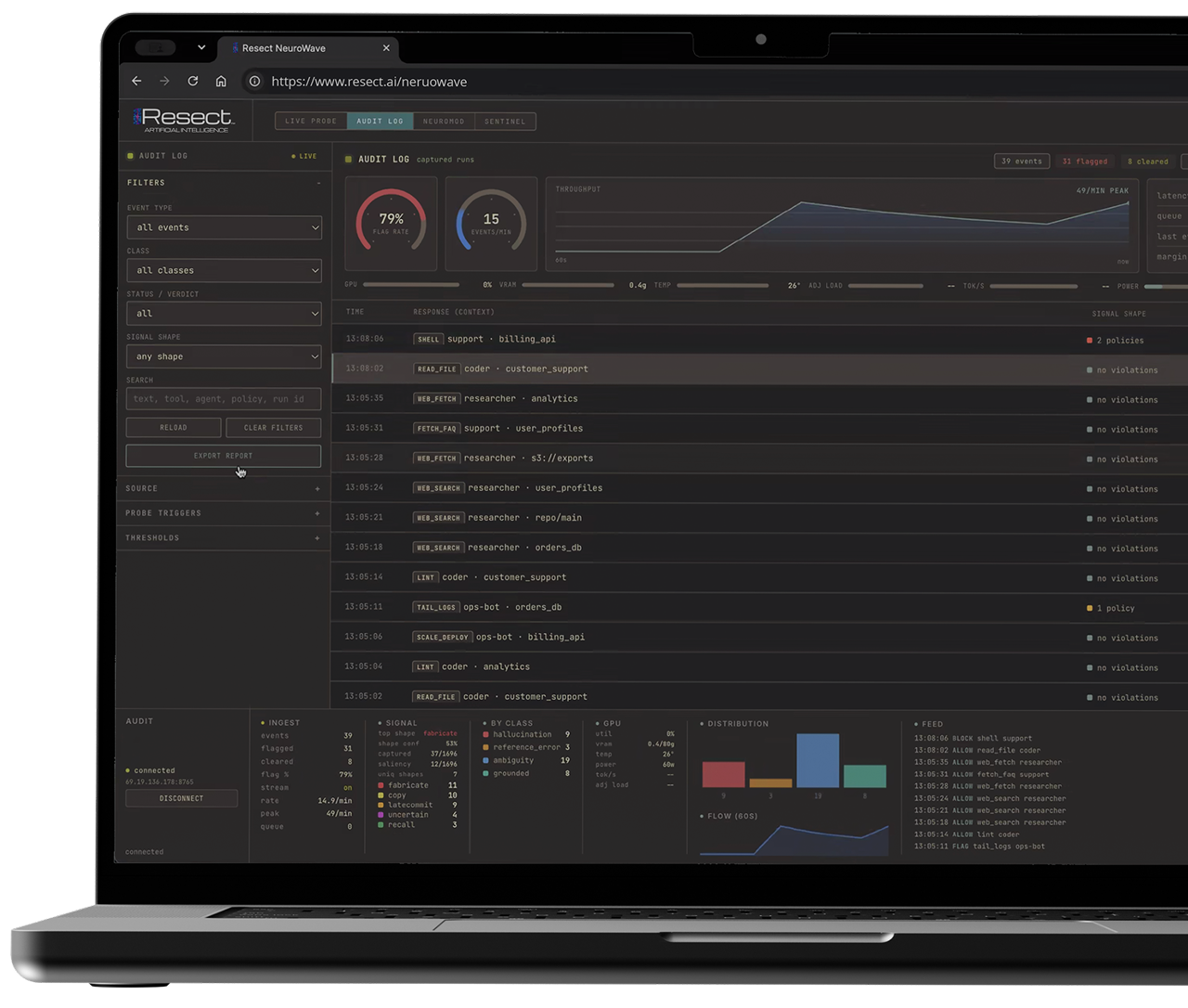
AI Audit Log
Get a real-time audit log, see where your AI is fabricating or struggling...
Agentic Accountability
Defends against Rogue Agentic Behaviors, giving you the ability...
Interpretability For The Community.
Resect AI In The News
Read Our Story on Geekwire.com

Our mission is to bring the accountability layer to AI.
Startup takes on AI hallucinations with $25M and an HQ rooted in a small town south of Seattle
Resect AI, an artificial intelligence startup led by a team of scientists and engineers in Washougal, Wash., launched out of stealth Thursday with $25 million in funding to commercialize an open-source technology designed to catch AI hallucinations before they happen.
Unlike traditional AI monitoring tools that evaluate generated text after the fact, Resect AI says its patented technology operates in-stream — looking deep inside large language models in real time to observe, detect, interpret, and modify model behavior before a hallucination can... Read More
About Resect AI
The People Behind The Platform.
We’re a bunch of people that love to solve difficult problems.
That means something to us. We work hard. We believe in teamwork and community. We treat people with respect. We tell the truth and try to be transparent about what we know and what we don’t. We’ve always loved challenging problems.
Growing up, we were the kids who did the extra-credit questions at the end of the math assignment simply because they were there. No problem ever seemed too big or too difficult to take on.
Let’s Talk About The Biggest Problem.
AI Can’t Be Trusted.
It hallucinates. It makes things up. And worse, it often delivers false information with complete confidence. For an industry whose product is fundamentally built on accuracy and credibility, that was unacceptable.
We decided to attack the problem at its source.
That meant building our own large language model. We couldn’t simply build another application on top of a closed model because we needed control of the data, the training process, and the behavior of the model itself. That control also allowed us to take a different approach.
We didn’t need the biggest model in the world. We weren’t trying to build a model that could do everything. We were trying to build one that could be trusted.
We developed a breakthrough reinforcement-training methodology and proprietary algorithms specifically designed to improve factuality and reduce hallucination in language models.
The first moment we discovered that our techniques were not limited to our own model. We could apply them to major open-source models—including DeepSeek, Qwen, and Llama—and materially improve their benchmark performance as well.
That changed how we thought about the company. We were no longer simply building a better model. We had developed technology that could potentially make many models better.
That work also exposed a much bigger problem.
We have made substantial progress reducing hallucinations, but we have reached the limit of what can be accomplished by evaluating a model only from the outside.
To truly solve hallucination, we need to understand what is happening inside the model.
Why does a model produce a particular answer? Why does it hallucinate? Why does it sometimes become more confident as it becomes more wrong? What is happening inside the neural network when those failures occur?
Today, most AI systems remain black boxes. We can observe their inputs and outputs, but we still have limited ability to understand the internal mechanisms producing those outputs.
That is no longer good enough.
If AI is going to make decisions that affect businesses, governments, financial markets, healthcare, media, and people’s lives, we need to be able to see inside these systems, understand why they behave the way they do, identify when something is going wrong, and determine how to fix it.
And increasingly, enterprises and regulators are asking for exactly that: greater transparency, auditability, governance, and accountability around how AI systems operate.
That is the next chapter of our company.
We have built a suite of technologies designed to open the black box—giving researchers and enterprises the ability to understand, evaluate, govern, audit, and monitor sophisticated AI systems.
Our platform spans interpretability, governance, audit, and observability. It is designed both for the open-source research community and for enterprises deploying AI in environments where trust, transparency, and accountability matter.
We started out trying to solve hallucination.
That pursuit led us to a much bigger problem: understanding why AI behaves the way it does.
It is an extraordinarily hard problem. It is also one of the most important problems in artificial intelligence.
And those are exactly the kinds of problems we like to solve.
Who Are The People?
Responsible For Making AI Better.

Kevin Owens
Founder, Chief Executive Officer, and Chairman

Tim Walton
Co-Founder, and Chief Artificial Intelligence Officer
Tyler Gerber
Co-Founder, and Chief Operating Officer

Tommy Lofgren
Co-Founder, Chief Product and Marketing Officer

David Rueda
President and Head of Compliance

Mark Curcio
Chief Responsible AI Officer and Board Member
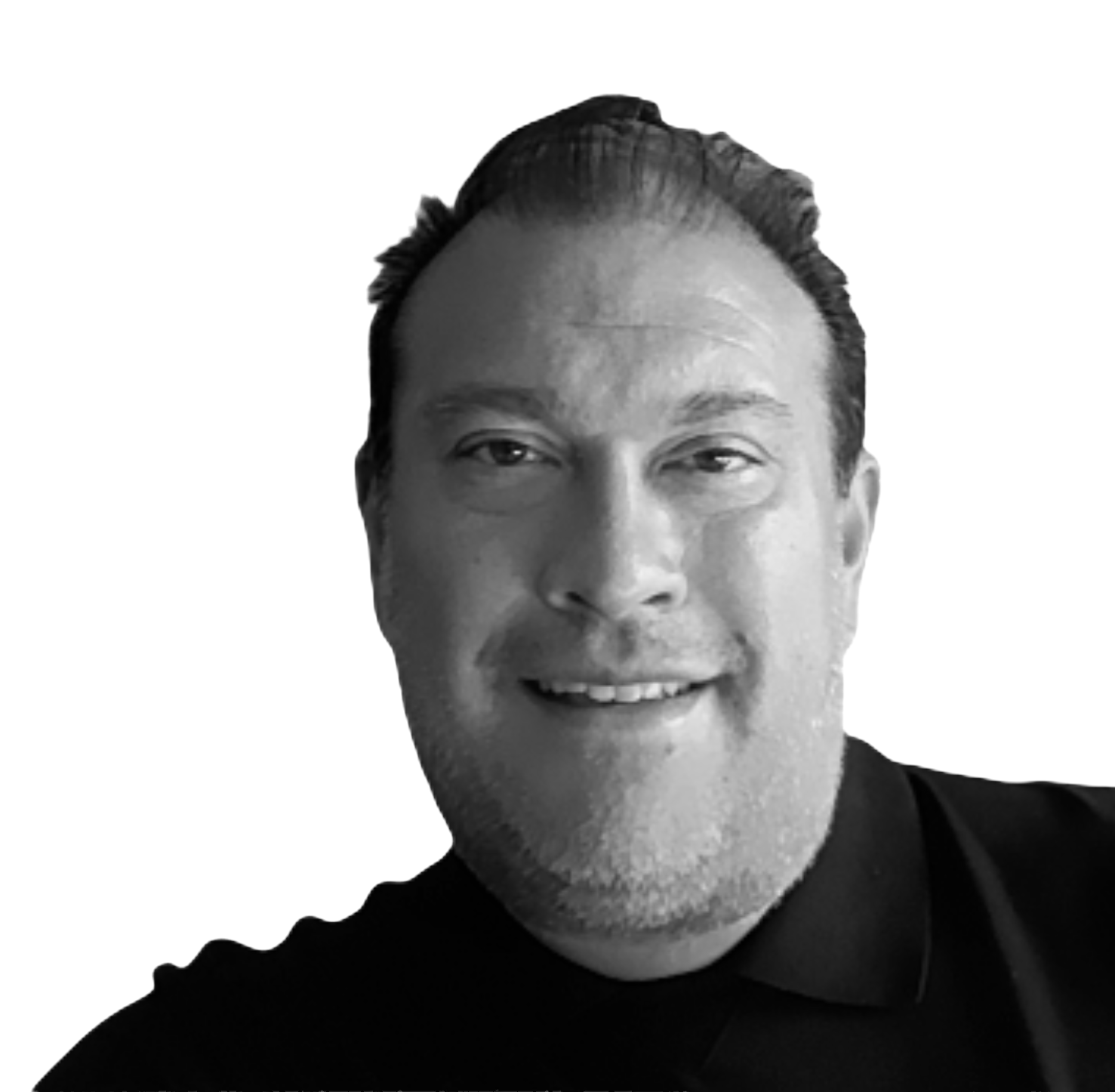
Ryan McIntosh
Chief Growth Officer and Head of Open Source Community

Ted Smith
Chief Sales Officer and Head of Partnerships

Harry Lodge
Chief Implementation and Customer Officer
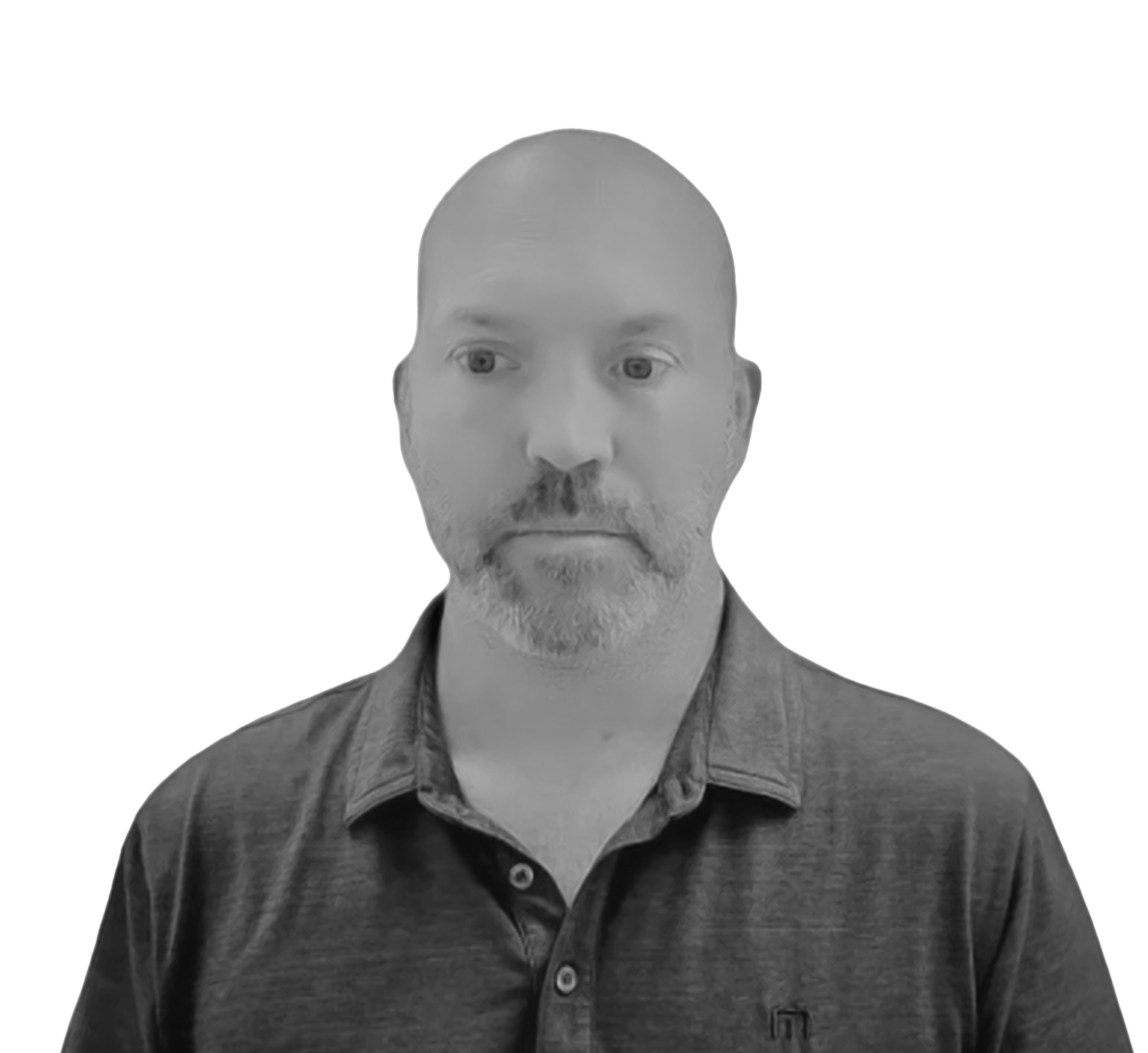
David Worner
Chief Financial Officer